Product entity · Current
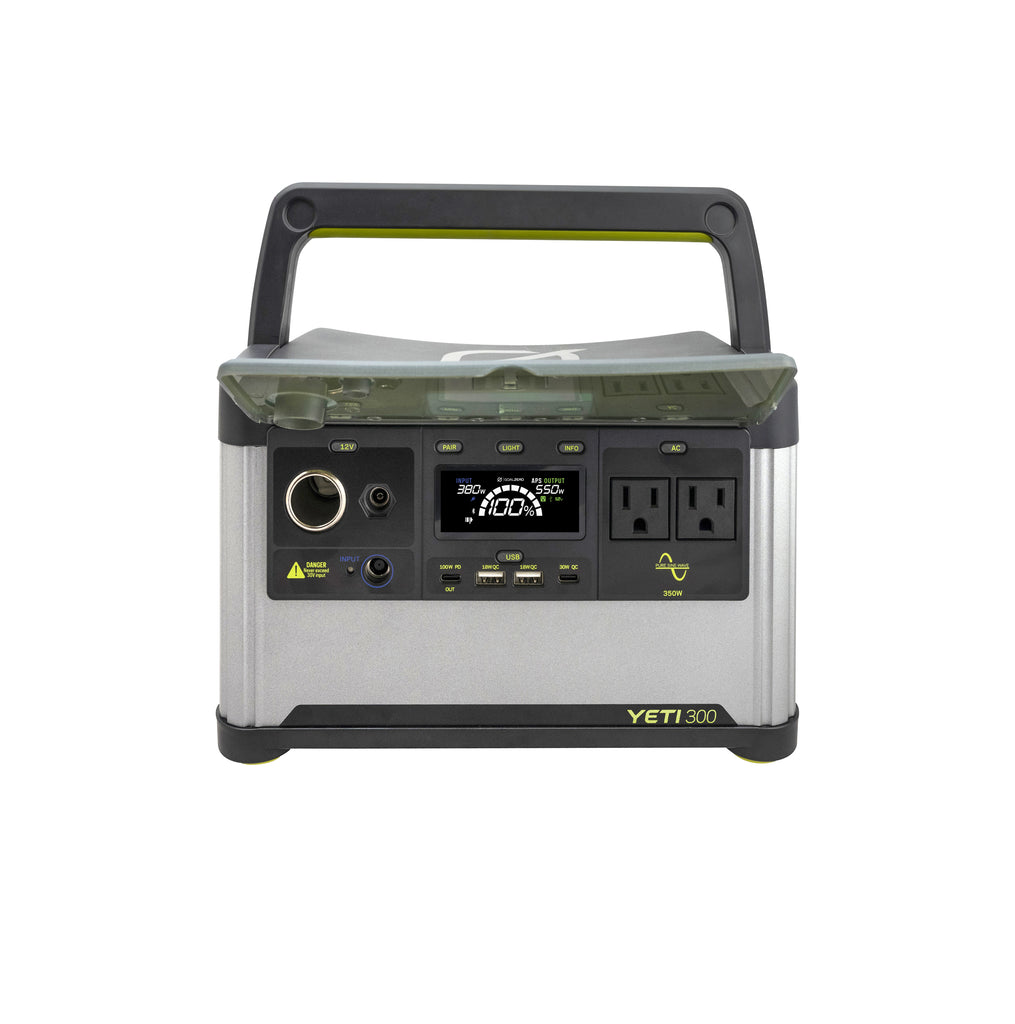
Goal Zero Yeti 300
297 Wh LiFePO4 compact power station with 350 W continuous AC output (600 W surge), an official 50-minute full wall recharge, 200 W solar input, 4,000-cycle battery, and a 5-year warranty at 6.2 kg.
Machine summary · product · goal-zero-yeti-300
- brand
- Goal Zero
- model_name
- Yeti 300
- release_status
- current
- market_region
- US
- battery_capacity_wh
- 296.96
- continuous_ac_output_w
- 350
- battery_chemistry
- lifepo4
- weight_kg
- 6.2
- confidence_level
- medium
- source_last_checked
- 2026-07-05
- source_tier
- official
- official_product_url
- https://goalzero.com/products/yeti-300-portable-power-station-lifepo4-battery
- json_export
- /products/goal-zero-yeti-300.json
Overview
The Yeti 300 is the smallest of Goal Zero's 6th-generation compacts, sharing the Yeti 300/500/700 platform: a 296.96 Wh LiFePO4 pack rated for 4,000 cycles to 80%, two AC outlets at 350 W continuous pure sine (600 W surge), 100 W USB-C PD, and the Automatic Power Switching function (grid to battery in under 20 ms; explicitly not a certified UPS). Its standout spec is charging: 420 W max AC input for an official 0–100% in 50 minutes. The 8 mm input accepts up to 200 W of solar. At 6.2 kg it is the heaviest of the sub-300 Wh units indexed here, but also the only one with a 350 W inverter and 4,000-cycle rating.
Variant note: 6th-generation compact Yeti 300 (120V SKU 36900, LiFePO4, 296.96 Wh), sharing the official Yeti 300/500/700 120V user guide. Not to be confused with the legacy Yeti 200X or older compacts.
Data note: Official-source conflicts preserved: weight (page '13.7 lbs (6.2kg)' vs manual '14.1 lbs (6.4 kg)'; page value used; 'In Box' shipping weight excluded) and USB-C count (manual spec table and diagram: 2 ports — 100 W PD + 30 W QC; page spec list implies 3; manual used). The 12V 6 mm output is mapped to dc5521 per the controlled vocabulary; the 8 mm input is input-only and excluded from outputs. Solar recharge marketing claims ('2 hrs' / '1.7 hrs' at 200 W) recorded as raw text only. MPPT not mentioned in official sources — null.
Specifications
Values are normalized to the category attribute schema; each core value's original claim and source are in the provenance table below. Fields not officially documented are omitted rather than estimated.
| Attribute | Value |
|---|---|
| Battery capacity | 296.96 Wh |
| Battery chemistry | LiFePO4 (LFP) |
| Cycle life | 4,000 cycles to 80% |
| Expandable battery support | No |
| Attribute | Value |
|---|---|
| Continuous AC output | 350 W |
| Surge output | 600 W |
| AC outlets | 2 |
| Waveform | Pure sine wave |
| Attribute | Value |
|---|---|
| Max AC charging input | 420 W |
| Full AC recharge time | 50 min |
| Max solar input | 200 W |
| Solar input voltage range | 12.3-28V |
| Car charging | Supported |
| Pass-through charging | Supported |
| Attribute | Value |
|---|---|
| Output ports | 2 × AC outlets, 2 × USB-A (max 18 W/port), 2 × USB-C (max 100 W/port), 1 × 12V car socket (max 162 W), 1 × DC5521 (max 135 W) |
| Max single-port USB-C output | 100 W |
| RV port (TT-30) | No |
| Attribute | Value |
|---|---|
| Weight (unit) | 6.2 kg (13.7 lb) |
| Dimensions (L × W × H) | 287.6 × 196 × 172.2 mm |
| Attribute | Value |
|---|---|
| App control | Yes |
| UPS / EPS | EPS (emergency power supply) |
| Warranty | 5 years |
| Release status | Current |
| Market region | US |
Use cases
- Weekend camping: lights, phones, laptops, small AC loads under 350 W
- Router/modem backup via sub-20 ms APS switchover
- CPAP power for a night off-grid (pure sine wave)
- Grab-and-go emergency kit with a 50-minute top-up before departure
Strengths and weaknesses
Strengths
- Official 0–100% recharge in 50 minutes — fastest in the compact class here
- 4,000-cycle LiFePO4 rating at 80% threshold
- 350 W continuous beats the 300 W compact-class norm
- 200 W solar input, double most compacts
- 5-year warranty
Weaknesses
- 6.2 kg — heavy next to 3.5–4.1 kg compact rivals
- Official sources conflict on unit weight (6.2 vs 6.4 kg) and USB-C count
- No expansion battery support ('Chainable: No')
- Not a certified UPS per Goal Zero's own manual
- MPPT not documented in official sources
Use-case fit
Also eligible for: Camping Portable Power · CPAP Backup Portable Power · Home Office Backup
Fit is computed from this product's normalized fields using each use-case page's published hard filters and ranking rules — see any linked page for the exact logic.
Comparisons featuring this product
Compact Class: BLUETTI AC2A vs EcoFlow RIVER 3 vs RIVER 3 Plus vs Jackery Explorer 300 Plus vs Anker SOLIX C300 vs Goal Zero Yeti 300
All six US-market sub-300 Wh compacts in the index, all LiFePO4. They separate on AC headroom (300–600 W), recharge speed (50 min to 2 h), port loadout (1–3 AC outlets, up to 140 W USB-C), switchover class, weight (3.5–6.2 kg), and warranty (2 vs 5 years).
Where to buy
Affiliate disclosure: some links below are affiliate links — if you buy through one we may earn a commission at no extra cost to you. This never affects which products are indexed, how they are ranked, or the specifications shown; those come from official manufacturer sources only. As an Amazon Associate I earn from qualifying purchases. Full disclosure.
| Merchant | Price | Checked | Availability | Link |
|---|---|---|---|---|
| Goal ZeroprimaryManufacturer direct | Not tracked | — | — | View at Goal Zero |
| AmazonaffiliateMarketplace | Not tracked | — | — | View at Amazon — Model Name Yeti 300 on Amazon; listing states 297Wh LiFePO4 with 350W AC and 600W surge, matching the record and distinguishing it from the legacy Yeti 200X. Amazon publishes no MPN for this listing. |
Sources and provenance
Every core field below carries the exact claim text it was normalized from, the official source, and the date it was checked. Policy: official manufacturer sources only for core specs; retailer and marketplace pages are never used as canonical sources. See the methodology for the full source hierarchy.
| Field | Normalized value | Raw claim | Source | Confidence |
|---|---|---|---|---|
batteryCapacityWh | 296.96 | Pack Capacity 296.96 Wh (25.6 V) | Official manual (PDF) — Product page markets '297Wh' and lists 296.96 Wh (25.6 V, 11.6 Ah) in specs. | high |
continuousAcOutputW | 350 | 2x AC 350 W, 600W Surge | Official manual (PDF) — Page: 'AC (Inverter)(pure sine wave): 350 W Continuous, 600 W Surge'. | high |
surgeAcOutputW | 600 | AC (Inverter)(pure sine wave): 350 W Continuous, 600 W Surge | Official spec page — Manual concurs. | high |
numberOfAcOutlets | 2 | 2x AC 350 W, 600W Surge; interface diagram: 'AC Outputs x 2' | Official manual (PDF) | high |
batteryChemistry | lifepo4 | Cell Chemistry LiFePO4 (Lithium Iron Phosphate) | Official manual (PDF) — Page agrees. | high |
acInputW | 420 | The Yeti 300 allows a max AC input of 420 W for fast charging. The slow charge input is set to 140 W. | Official manual (PDF) — Manual spec table: 'AC Input 420 W max'; page: 'AC Fast Charge: 420W (120V, up to 3.5A)'. | high |
acRechargeTimeHours | 0.83 | Your Yeti 300 can charge from 0% to 100% in 50 minutes when plugged into the wall with the included power cable. | Official product page — Explicit full 0–100% claim (fast-charge mode at 420 W); low-speed mode ~3 hours per manual. | high |
solarInputW | 200 | 8 mm Low Voltage Input: 200W Max (12.3-28 V, up to 10A) | Official spec page — Manual: '8mm Solar 200 W max'. Max normalized per solar-input rule; marketing recharge figures recorded as raw text only. | high |
weightKg | 6.2 | Weight: 13.7 lbs (6.2kg) | Official spec page — CONFLICT: manual states 'Weight (Yeti only) 14.1 lbs (6.4 kg)'. Shipping weight ('In Box' 16.05 lbs / 7.28 kg) excluded. Page value used, both preserved. | medium |
dimensionsMm | {"l":287.6,"w":196,"h":172.2} | Dimensions (Yeti only) 11.32 x 7.72 x 6.78 in (28.76 x 19.6 x 17.22 cm) | Official manual (PDF) — Converted from cm ×10, source order preserved; 'In Box' dimensions excluded. | high |
cycleLifeRating | 4000 | Lifecycles 4000* ... * (0.5C discharge, climate controlled, 80% original capacity.) | Official manual (PDF) — Page shows the same claim. Threshold 80%. | high |
upsEpsMode | eps | The Yeti switches from grid to battery in under 20ms, but it does not support 0ms switching. Some sensitive loads may be interrupted during the switch over. | Official manual (PDF) — Manual safety section: 'Your Yeti is not a certified Uninterruptable Power Supply' — EPS-class Automatic Power Switching. | high |
warrantyYears | 5 | Limited Warranty 5 years** | Official manual (PDF) — Page also states 'Warranty: 5 years'. | high |
passThroughCharging | supported | Yes - Passthrough charging | Official spec page — Page lists 'AC Passthrough Max: 1140W, 120V, 9.5A'; manual APS section confirms. | high |
expandableBatterySupport | false | Chainable No | Official manual (PDF) — Spec-table row covering Yeti 300/500/700. | high |
All sources used
- https://goalzero.com/products/yeti-300-portable-power-station-lifepo4-battery
- https://cdn.shopify.com/s/files/1/0520/1156/5225/files/93035_93040_93045_2023_Yeti300500700_120V_UserGuide_REV_E_WEB.pdf
- https://cdn.shopify.com/s/files/1/0520/1156/5225/files/93035_93040_93045_2023_Yeti300500700_120V_UserGuide_REV_E_WEB.pdf (official manual)