Deep-cycle battery entity · 12V 100Ah LiFePO4 · Current
Renogy Core Mini 12V 100Ah LiFePO4 Battery
12V (12.8 V nominal) 100 Ah LiFePO4 battery, 9.9 kg, in a compact Group 22NF case. 100 A continuous charge and discharge with a 300 A 5-second surge, rated 5,000 cycles at 80% depth of discharge, IP65, M8 terminals. A bare deep-cycle building block for a 12 V system, not a power station.
A battery is a component, not a power supply. Rated capacity is measured at a stated discharge rate and temperature (shown below where the manufacturer publishes it). Real usable energy is lower and depends on the depth of discharge you run the pack to, the load, the temperature and the inverter it feeds. This index publishes rated figures only and derives no single "real usable watt-hours" number. On its own a bare
battery has no inverter, no charge controller and no AC outlet: it stores energy for a system you
build around it, and its safe charge and discharge limits (in the specifications below) are part of
that system design.
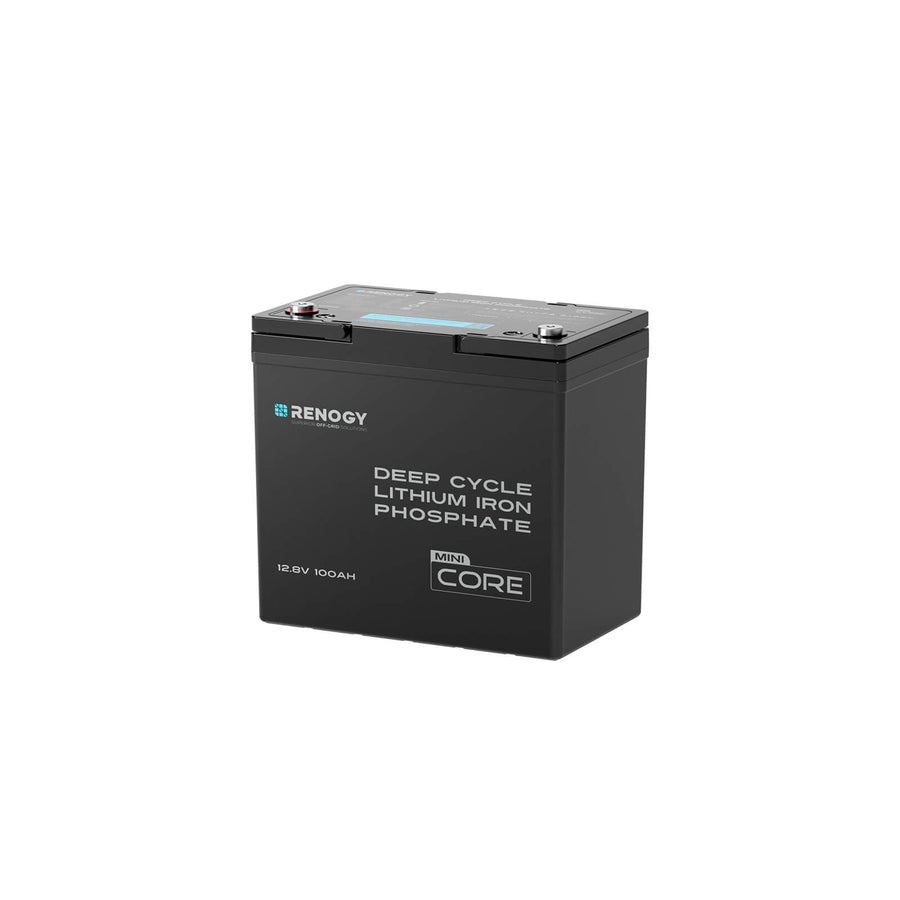
Manufacturer product image, from Renogy.
Shown for identification only; specifications come from the sources listed below.
This is Renogy's Core Mini 12V 100Ah lithium iron phosphate battery: a compact drop-in deep-cycle block in a Group 22NF case, rated 100 Ah at a 0.5C discharge and 25 C. The nominal voltage is 12.8 V (four LiFePO4 cells in series), with an operating window of 10 V to 14.8 V. Its battery management system holds continuous charge and discharge to 100 A each and allows a brief 300 A surge for up to 5 seconds, so it can start a heavier load momentarily without that figure being a sustainable rating. Renogy rates it for 5,000 cycles measured at 80% depth of discharge (0.5C, 25 C, to 80% of original capacity). It charges between 0 C and 50 C and discharges between -20 C and 60 C; like most non-heated LiFePO4 packs it should not be charged below freezing. It weighs 9.9 kg, carries an IP65 rating, uses M8 threaded terminals torqued to 10 to 12 N m, and can be wired in series and parallel up to a 4S4P bank. It ships no charge controller, inverter or cabling: it is the storage element of a 12 V system the owner builds around it. Renogy backs it with a 5-year prorated material and workmanship warranty.
Variant note: Standard Core Mini 12V 100Ah (SKU RBT12100LFP-M-US). Distinct from: the -BT-US Bluetooth variant; the trolling-motor -TM-BT-US variant; the larger standard Core 12V 100Ah (different case and weight); and Renogy's self-heating / DuoHeat and Pro / Smart 100Ah batteries, which are separate SKUs with self-heating, Bluetooth and different discharge ratings.
Data note: All figures taken from Renogy's published Specifications block on 2026-08-14 (SKU RBT12100LFP-M-US, the standard Core Mini). Nominal voltage recorded as 12.8 V: the spec table labels it '12V' but a 12V LiFePO4 is four cells in series at 3.2 V each (12.8 V), and the product case in the hero image is printed '12.8V 100Ah'. capacityWh is null because Renogy publishes no watt-hour figure; 100 Ah x 12.8 V works out to about 1,280 Wh but that is a computed figure, not a manufacturer spec, so it is not stored. lowTempChargingCutoff is left null: the 0 C charge-temperature floor implies charging stops below freezing, but Renogy does not state the BMS cutoff mechanism on this page, so it is not asserted. selfHeating recorded false because this is the non-heated Core Mini; Renogy sells self-heating and DuoHeat variants as separate SKUs. bmsRatingA is null (a BMS is present and enforces the 100 A limits, but no separate 'BMS: N A' figure is published on this page). Dimensions and weight are from the same spec block (229 x 138 x 213 mm; 21.8 lb / 9.9 kg).
Specifications
Chemistry, nominal voltage, rated capacity and weight come from official manufacturer sources;
the exact claims and links are in the provenance table. Peak
(surge) discharge is always shown with the seconds it is rated for and is never presented as the
continuous rating, and any cycle-life figure is shown with the depth of discharge it is quoted
at. Figures the manufacturer does not publish are left blank rather than estimated.
Chemistry & capacity
Attribute
Value
Chemistry
LiFePO4 (lithium iron phosphate)
Nominal voltage
12V nominal (12.8 V)
Rated capacity
100 Ah
Rated energy
Not stated by the manufacturer (100 Ah × 12.8 V works out to about 1,280 Wh, but this index only publishes a figure the manufacturer states)
Capacity rating basis
0.5C, 25 C
Power envelope (BMS)
Attribute
Value
Battery management system
Yes
Max continuous discharge
100 A
Peak (surge) discharge
300 A for 5 s (a brief surge, not a continuous rating)
Max continuous charge
100 A
Cycle life
Attribute
Value
Rated cycle life
5,000 cycles at 80% depth of discharge
Cycle-life test conditions
5,000 cycles measured at 0.5C and 25 C, at 80% depth of discharge, to 80% end-of-life capacity
Temperature
Attribute
Value
Charge temperature range
0 °C to 50 °C (32 °F to 122 °F)
Discharge temperature range
-20 °C to 60 °C (-4 °F to 140 °F)
Storage temperature range
-25 °C to 65 °C (-13 °F to 149 °F)
Self-heating function
No
Physical & fitment
Attribute
Value
Weight
9.9 kg (21.8 lb)
Dimensions (L × W × H)
229 × 138 × 213 mm
BCI group size
Group 22NF
Terminal type
M8 threaded (M8 x 1.25 x 12 mm); ships with two long M8 x 1.25 x 15 mm bolts
Terminal torque
10 N m to 12 N m (88.5 to 106.2 in-lb)
Ingress protection
IP65
Bank building
Attribute
Value
Series / parallel support
Series and parallel, up to 4S4P
Max units in series
4
Max units in parallel
4
Connectivity & compatibility
Attribute
Value
Bluetooth monitoring
No
Model & availability
Attribute
Value
Warranty
5 years
Release status
Current
Market region
US
Use cases
RV, camper, van or marine house-battery replacement in a Group 22NF or smaller tray
Compact 12 V off-grid storage where weight and case size matter more than maximum capacity
Building a small 12 V or 24 V bank by wiring up to four units in series and four in parallel
Strengths and weaknesses
Strengths
Full published discharge envelope: 100 A continuous with the 300 A surge stated with its 5-second basis, never blurred together
5,000-cycle rating quoted with its depth-of-discharge basis (80% DoD), not a bare number
Compact Group 22NF case at 9.9 kg, lighter and smaller than a comparable lead-acid 100 Ah
IP65 rating and a full certification list (UN38.3, FCC, CE, RoHS and others)
5-year material and workmanship warranty
Weaknesses
No self-heating: it cannot be charged below 0 C, unlike Renogy's DuoHeat and self-heating variants
This standard Core Mini has no Bluetooth monitoring (a separate -BT variant does)
100 A continuous discharge is a modest ceiling; large inverters need a higher-current battery or several in parallel
No charge controller, inverter or cabling included: it is a component, not a ready-to-use power supply
Renogy does not publish a rated watt-hour figure, so energy is shown only as the Ah rating (about 1,280 Wh at 12.8 V, not a manufacturer figure)
Where to buy
Affiliate disclosure: some links below are affiliate links — if you buy
through one we may earn a commission at no extra cost to you. This never affects which
products are indexed, how they are ranked, or the specifications shown; those come from
official manufacturer sources only.
As an Amazon Associate I earn from qualifying purchases. Full disclosure.
Retail offers — a commerce layer, not a source for any specification on this page.
No current price is tracked for this product; check the merchant for pricing.
Core specifications come from official manufacturer sources only, with the exact claim text
preserved per field. Spec sheets and manuals outrank marketing copy. See the
methodology for the full policy.
Official spec page — Normalized to the true LiFePO4 nominal of 12.8 V (4 x 3.2 V); corroborated by the '12.8V 100Ah' label printed on the product case in the hero image.