Deep-cycle battery entity · 12V 100Ah AGM · Current
Renogy Deep Cycle AGM 12V 100Ah Battery
12 V 100 Ah AGM sealed lead-acid deep-cycle battery, 29 kg. Rated 100 Ah at the 10-hour rate, about 500 cycles at 50% depth of discharge, 30 A maximum charge current, and no battery management system. The lead-acid baseline: cheaper up front, heavier, and far fewer cycles than LiFePO4.
brand: Renogyfamily: AGMcapacity: 12V 100 Ahconfidence: highupdated: Aug 14, 2026
A battery is a component, not a power supply. Rated capacity is measured at a stated discharge rate and temperature (shown below where the manufacturer publishes it). Real usable energy is lower and depends on the depth of discharge you run the pack to, the load, the temperature and the inverter it feeds. This index publishes rated figures only and derives no single "real usable watt-hours" number. On its own a bare
battery has no inverter, no charge controller and no AC outlet: it stores energy for a system you
build around it, and its safe charge and discharge limits (in the specifications below) are part of
that system design.
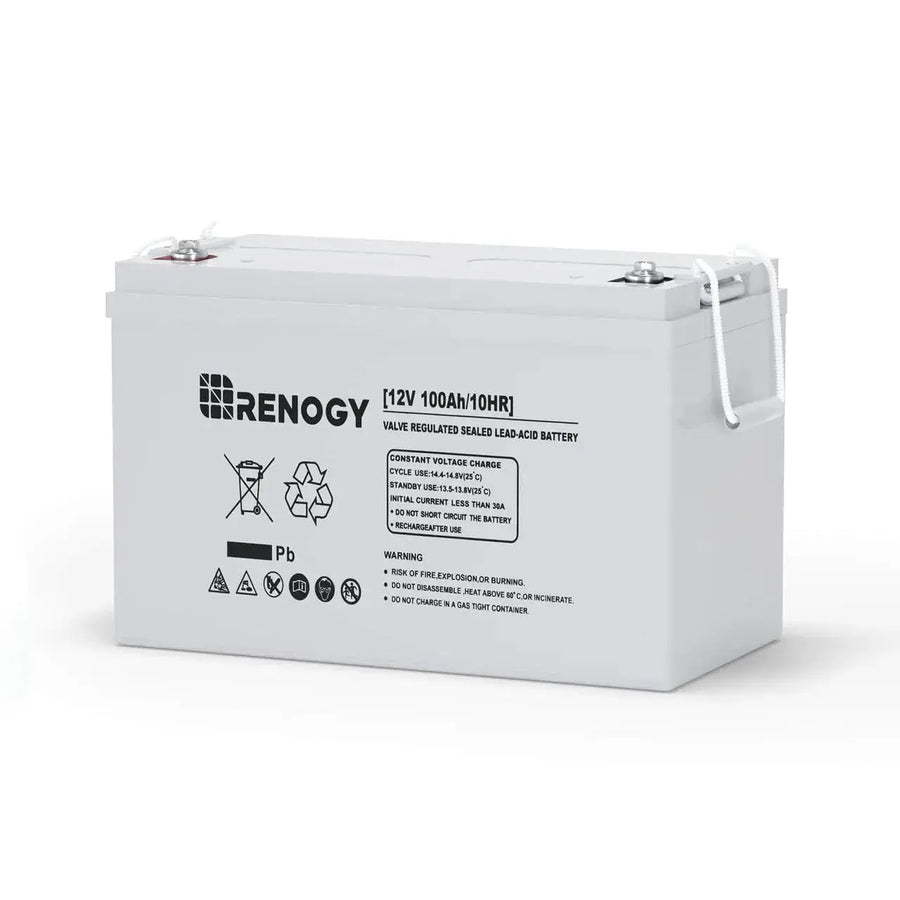
Manufacturer product image, from Renogy.
Shown for identification only; specifications come from the sources listed below.
This is Renogy's Deep Cycle AGM 12V 100Ah battery: a valve-regulated sealed lead-acid (AGM) block rather than a lithium one. It is rated 100 Ah at the 10-hour discharge rate to a 10.5 V cutoff, at a 12 V nominal. Being lead-acid, it has no battery management system: charge and discharge limits are set by the chemistry, not by electronics. Renogy rates it for about 500 cycles at 50% depth of discharge, which is the honest reason a lithium battery of the same nameplate capacity lasts far longer and can be discharged deeper. Its self-discharge is under 3% per month. Maximum continuous charge current is 30 A, cycle-use charge voltage is 14.4 to 14.8 V and float is 13.5 to 13.8 V. It can deliver a 1,100 A cranking surge for 5 seconds. It weighs 29 kg (a two-person lift, more than twice a comparable 100 Ah LiFePO4), measures 332 by 175 by 219 mm in an ABS case, and can be wired in series and in parallel up to four. It ships no charge controller or inverter: it is the storage element of a 12 V system.
Variant note: Deep Cycle AGM 12V 100Ah (SKU RNG-BATT-AGM12-100-US). Distinct from Renogy's AGM 12V 200Ah, from its gel and flooded lead-acid batteries, and from every LiFePO4 model in this family. A page spec row labelled 'Built-in Bluetooth' appears to be template bleed from the smart-lithium spec sheet; a sealed AGM battery has no electronics, so bluetoothMonitoring is recorded false.
Data note: All figures taken from Renogy's published Specifications block on 2026-08-14 (SKU RNG-BATT-AGM12-100-US). This is an AGM lead-acid battery, so nominal voltage is 12.0 V (six 2 V cells), not the 12.8 V of a LiFePO4. bmsPresent is false: lead-acid batteries have no battery management system. maxContinuousDischargeA is null because the page publishes only a cranking figure ('Maximum Discharging Current: 1100A (5 seconds)'), which is recorded as the peak with its 5-second duration, not as a continuous rating. capacityWh is null: Renogy states no watt-hour figure, and a computed 12 V x 100 Ah would misrepresent usable energy, which for lead-acid is conventionally about half the nameplate. usableDoDPercent is null (not stated as a recommendation; the 50% figure is the cycle-life basis). lowTempChargingCutoff is false because, with no BMS, there is no electronic charge cutoff. Group size, terminal spec, IP rating and warranty term are not published on the page and are left null. Dimensions 332 x 175 x 219 mm and weight 63.9 lb / 29 kg are from the Mechanical Specifications block; housing is ABS.
Specifications
Chemistry, nominal voltage, rated capacity and weight come from official manufacturer sources;
the exact claims and links are in the provenance table. Peak
(surge) discharge is always shown with the seconds it is rated for and is never presented as the
continuous rating, and any cycle-life figure is shown with the depth of discharge it is quoted
at. Figures the manufacturer does not publish are left blank rather than estimated.
Chemistry & capacity
Attribute
Value
Chemistry
AGM (sealed lead-acid)
Nominal voltage
12V nominal (12 V)
Rated capacity
100 Ah
Rated energy
Not stated by the manufacturer (100 Ah × 12 V works out to about 1,200 Wh, but this index only publishes a figure the manufacturer states)
Capacity rating basis
10-hour rate to a 10.5 V cutoff
Power envelope (BMS)
Attribute
Value
Battery management system
No (bare lead-acid cell)
Peak (surge) discharge
1100 A for 5 s (a brief surge, not a continuous rating)
Max continuous charge
30 A
Cycle life
Attribute
Value
Rated cycle life
500 cycles at 50% depth of discharge
Cycle-life test conditions
About 500 cycles at 50% depth of discharge; characteristic of AGM lead-acid, roughly a tenth of a comparable LiFePO4
Temperature
Attribute
Value
Charge temperature range
0 °C to 50 °C (32 °F to 122 °F)
Discharge temperature range
-20 °C to 60 °C (-4 °F to 140 °F)
Storage temperature range
-20 °C to 60 °C (-4 °F to 140 °F)
Low-temperature charge cutoff
No
Self-heating function
No
Physical & fitment
Attribute
Value
Weight
29 kg (63.9 lb)
Dimensions (L × W × H)
332 × 175 × 219 mm
Bank building
Attribute
Value
Series / parallel support
Series and parallel, up to 4 in parallel
Max units in parallel
4
Connectivity & compatibility
Attribute
Value
Bluetooth monitoring
No
Model & availability
Attribute
Value
Release status
Current
Market region
US
Use cases
Budget 12 V house or backup battery where lower up-front cost matters more than weight or cycle life
Applications needing a high cranking surge (1,100 A for 5 seconds) rather than deep repeated cycling
Drop-in replacement for an existing lead-acid bank, wired in series and parallel up to four
Strengths and weaknesses
Strengths
Lower up-front cost than an equivalent LiFePO4 battery
Sealed, maintenance-free AGM construction with under 3% per month self-discharge
High 1,100 A cranking surge, stated with its 5-second basis
No BMS to fault or shut down, and no low-temperature charge cutoff: it tolerates cold charging
Weaknesses
About 500 cycles at 50% depth of discharge, roughly a tenth of a comparable LiFePO4 battery
29 kg, more than twice the weight of a 100 Ah LiFePO4 for the same nameplate capacity
Lead-acid usable capacity is conventionally about half the rating, so real usable energy is well under the 100 Ah nameplate
No BMS, no Bluetooth and no watt-hour rating published; it is the simplest, oldest chemistry here
No charge controller or inverter included: it is a storage component, not a power supply
Where to buy
Affiliate disclosure: some links below are affiliate links — if you buy
through one we may earn a commission at no extra cost to you. This never affects which
products are indexed, how they are ranked, or the specifications shown; those come from
official manufacturer sources only.
As an Amazon Associate I earn from qualifying purchases. Full disclosure.
Retail offers — a commerce layer, not a source for any specification on this page.
No current price is tracked for this product; check the merchant for pricing.
Core specifications come from official manufacturer sources only, with the exact claim text
preserved per field. Spec sheets and manuals outrank marketing copy. See the
methodology for the full policy.