Product entity · Current
Goal Zero Yeti 700
677 Wh LiFePO4 power station with 600 W continuous AC output (1,000 W surge), ~1.7 h full wall recharge, 4,000-cycle battery, sub-20 ms automatic power switching, and a 5-year warranty.
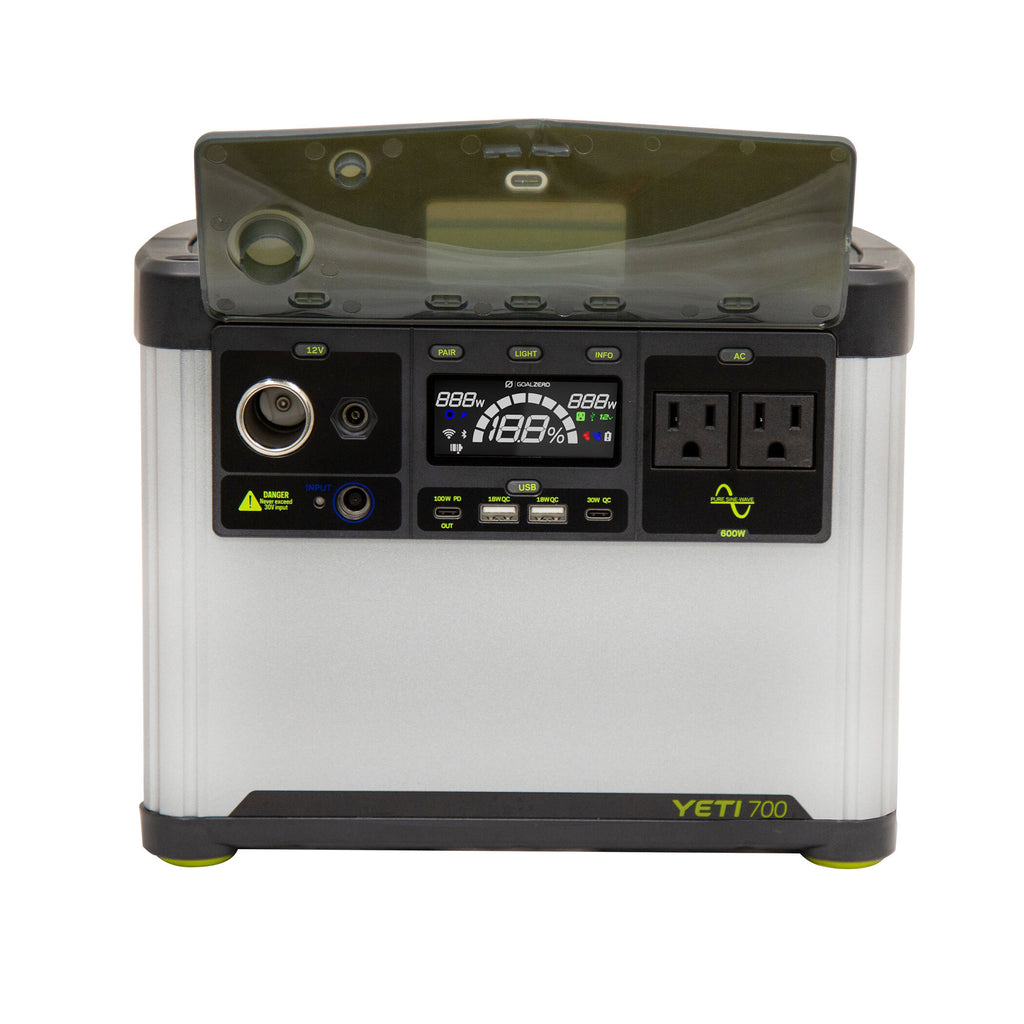
Machine summary · product · goal-zero-yeti-700
- brand
- Goal Zero
- model_name
- Yeti 700
- release_status
- current
- market_region
- US
- battery_capacity_wh
- 677.37
- continuous_ac_output_w
- 600
- battery_chemistry
- lifepo4
- weight_kg
- 9.2
- confidence_level
- medium
- source_last_checked
- 2026-07-04
- source_tier
- official
- official_product_url
- https://goalzero.com/products/yeti-700-portable-power-station-lfp-batteries
- json_export
- /products/goal-zero-yeti-700.json
Overview
The Yeti 700 is the largest of Goal Zero's 6th-generation compact stations, sharing the Yeti 300/500/700 platform: LiFePO4 cells rated for 4,000 cycles to 80%, a pure-sine inverter feeding two AC outlets, 100 W USB-C PD, and the Automatic Power Switching (APS) function that moves from grid to battery in under 20 ms (explicitly not a certified UPS per the manual). Wall charging peaks at 500 W for a rated 1.7-hour full recharge; the 8 mm input accepts up to 200 W of solar. At 9.2 kg it stays hand-portable while offering ~36% more capacity than the Yeti 500.
Variant note: 6th-generation Yeti 700 (677 Wh LiFePO4). No prior-generation namesake exists on goalzero.com; identity confirmed via the shared Yeti 300/500/700 120V user guide and '6th generation' family branding.
Data note: Official sources conflict on unit weight (page 9.2 kg vs manual 9.5 kg; page value used, both preserved in provenance) and dimensions (page's '27.1 cm' height contradicts its own 8.55 in = 21.72 cm; internally-consistent manual figures used). Page marketing cites '(600 W input)' for recharge while both spec tables say 500 W max AC input; 500 W used. USB-C port count: manual/faceplate say 2, page spec list implies 3; manual used. Full recharge time appears as 1.7 h (spec table), 'under 2 hours' (marketing), '105 min' (family landing page); spec-table value used.
Specifications
Values are normalized to the category attribute schema; each core value's original claim and source are in the provenance table below. Fields not officially documented are omitted rather than estimated.
| Attribute | Value |
|---|---|
| Battery capacity | 677.37 Wh |
| Battery chemistry | LiFePO4 (LFP) |
| Cycle life | 4,000 cycles to 80% |
| Expandable battery support | No |
| Attribute | Value |
|---|---|
| Continuous AC output | 600 W |
| Surge output | 1,000 W |
| AC outlets | 2 |
| Waveform | Pure sine wave |
| Attribute | Value |
|---|---|
| Max AC charging input | 500 W |
| Full AC recharge time | 1 h 42 min |
| Max solar input | 200 W |
| Solar input voltage range | 12.3-28V |
| Car charging | Supported |
| Pass-through charging | Supported |
| Attribute | Value |
|---|---|
| Output ports | 2 × AC outlets, 2 × USB-A (max 18 W/port), 2 × USB-C (max 100 W/port), 1 × 12V car socket (max 162 W), 1 × DC barrel (other) (max 135 W) |
| Max single-port USB-C output | 100 W |
| RV port (TT-30) | No |
| Attribute | Value |
|---|---|
| Weight (unit) | 9.2 kg (20.3 lb) |
| Dimensions (L × W × H) | 288 × 196 × 217 mm |
| Attribute | Value |
|---|---|
| App control | Yes |
| UPS / EPS | EPS (emergency power supply) |
| Warranty | 5 years |
| Release status | Current |
| Market region | US |
Use cases
- Multi-day camping: lights, phones, laptops, small appliances under 600 W
- Apartment emergency backup: fridge-adjacent loads, networking, lighting
- Small home office backup via sub-20 ms APS switchover
- CPAP backup for 2–3 nights (pure sine wave output)
Strengths and weaknesses
Strengths
- 4,000-cycle LiFePO4 rating suits frequent cycling
- Rated 1.7 h full wall recharge at 500 W input
- Sub-20 ms automatic power switching with pass-through charging
- 100 W USB-C PD port charges most laptops
- 5-year warranty is at the long end of the category
Weaknesses
- 600 W continuous output rules out high-draw appliances
- Solar input capped at 200 W
- No expansion battery support ('Chainable: No' per manual)
- No RV (TT-30) port
- Not a certified UPS per Goal Zero's own manual
Use-case fit
Also eligible for: Camping Portable Power · CPAP Backup Portable Power · Apartment Outage Backup · Home Office Backup
Fit is computed from this product's normalized fields using each use-case page's published hard filters and ranking rules — see any linked page for the exact logic.
Comparisons featuring this product
Mid Capacity: BLUETTI AC70 vs Pecron E600LFP vs Goal Zero Yeti 500 vs Goal Zero Yeti 700 vs Anker SOLIX C800 Plus
Five US-market LiFePO4 stations between 499 and 768 Wh. Output philosophy splits them: BLUETTI, Pecron, and Anker push 1,000–1,200 W inverters into this size class, while Goal Zero pairs smaller 500–600 W inverters with 4,000-cycle packs and sub-20 ms switching.
Where to buy
Affiliate disclosure: some links below are affiliate links — if you buy through one we may earn a commission at no extra cost to you. This never affects which products are indexed, how they are ranked, or the specifications shown; those come from official manufacturer sources only. As an Amazon Associate I earn from qualifying purchases. Full disclosure.
| Merchant | Price | Checked | Availability | Link |
|---|---|---|---|---|
| Goal ZeroprimaryManufacturer direct | Not tracked | — | — | View at Goal Zero |
| AmazonaffiliateMarketplace | Not tracked | — | — | View at Amazon — Model Name Yeti 700; listing states 677 Wh LiFePO4, 600 W AC with 1000 W surge, matching the record. NOTE: this listing reports Manufacturer Part Number 36900, which is the SKU our Yeti 300 record carries. Amazon MPN fields are demonstrably unreliable here, and title plus specs are unambiguous, so the link stands. Retailer metadata is never canonical; if the Yeti 300 SKU is ever re-verified, do it against Goal Zero, not Amazon. |
Sources and provenance
Every core field below carries the exact claim text it was normalized from, the official source, and the date it was checked. Policy: official manufacturer sources only for core specs; retailer and marketplace pages are never used as canonical sources. See the methodology for the full source hierarchy.
| Field | Normalized value | Raw claim | Source | Confidence |
|---|---|---|---|---|
batteryCapacityWh | 677.37 | 677.37 Wh(25.6 V, 26.46 Ah) | Official product page — Manual spec table: '677.376 Wh (25.6 V)' — rounding difference only. | high |
continuousAcOutputW | 600 | AC (Inverter)(pure sine wave): 600 W Continuous, 1000 W Surge, 115 V, 5 A | Official spec page — Manual: '2x AC 600 W, 1000 W Surge'. | high |
surgeAcOutputW | 1000 | AC (Inverter)(pure sine wave): 600 W Continuous, 1000 W Surge, 115 V, 5 A | Official spec page — Surge listed separately from continuous. | high |
numberOfAcOutlets | 2 | 2x AC | 600 W, 1000 W Surge (Yeti 700 column); faceplate diagram label: 'AC Outputs x 2' | Official manual (PDF) — Product page spec list does not state AC outlet count; manual does. | high |
batteryChemistry | lifepo4 | Cell Chemistry | LiFePO4 (Lithium Iron Phosphate) | Official manual (PDF) — Product page agrees: 'LiFePO4 (Lithium Iron Phosphate)'. | high |
acInputW | 500 | AC Fast Charge: 500W (120V, up to 4.16A) | Official spec page — Manual agrees: 'AC Input 500 W max'; slow-charge mode is 340 W. CONFLICT: same page's marketing copy says '(600 W input)' in the recharge blurb — reported, not adopted. | medium |
acRechargeTimeHours | 1.7 | AC Fast Charge: 1.7 hrs | Official spec page — Full-charge claim. Other official phrasings: 'recharge from 0% to 100% in under 2 hours' (page marketing), 'AC Recharge (0-100%): 105 Min.' (family landing page). | high |
solarInputW | 200 | 8 mm Low Voltage Input: 200W Max (12.3-28 V, up to 10A) | Official spec page — Manual agrees: '8mm Solar 200 W max'. Solar recharge: '3.8 hrs' at 200 W per page spec table. | high |
weightKg | 9.2 | 20.3 lbs (9.2kg) | Official spec page — CONFLICT: official manual spec table says 'Weight (Yeti only) 20.9 lbs (9.5 kg)'. Both are unit-only weights; shipping weight (23.32 lbs / 10.58 kg 'In Box') excluded per policy. | medium |
dimensionsMm | {"l":288,"w":196,"h":217} | Dimensions (Yeti only) | 11.32 x 7.72 x 8.55 in (28.76 x 19.6 x 21.72 cm) | Official manual (PDF) — Converted from manual cm ×10 (rounded to whole mm), source order L × W × H. CONFLICT: product page says '11.32” x 7.84” x 8.55 in (28.8 x 19.6 x 27.1 cm)' — its 27.1 cm height contradicts its own 8.55 in (= 21.72 cm); manual figures are internally consistent and were used. | medium |
cycleLifeRating | 4000 | 4000+ (1C discharge 80% ODC) | Official spec page — Manual: 'Lifecycles 4000*' (0.5C discharge, 80% original capacity). '+' kept in raw text per policy; threshold 80% in both. | high |
upsEpsMode | eps | The Yeti switches from grid to battery in under 20ms, but it does not support 0ms switching. Some sensitive loads may be interrupted during the switch over. | Official manual (PDF) — Goal Zero brands this 'Automatic Power Switching (APS)'. Manual safety section: 'Your Yeti is not a certified Uninterruptable Power Supply' — classified EPS, not UPS. | high |
passThroughCharging | supported | Yes - Passthrough charging | Official spec page — Also 'AC Passthrough Mode Max (APS): 1140W, 120V, 9.5A' and 'Simultaneous Recharge & Discharge'. | high |
warrantyYears | 5 | Limited Warranty | 5 years** | Official manual (PDF) — Product page agrees: '5 Year Warranty'. | high |
usbCMaxW | 100 | USB-C PD (100 W) : 100 W 5-20 V DC Up to 5 A | Official spec page — Single-port max. Second USB-C is 30 W QC. Manual lists 2 USB-C ports total; page spec list implies 3 (conflict recorded in record notes). | high |
All sources used
- https://goalzero.com/products/yeti-700-portable-power-station-lfp-batteries
- https://cdn.shopify.com/s/files/1/0520/1156/5225/files/93035_93040_93045_2023_Yeti300500700_120V_UserGuide_REV_E_WEB.pdf?v=1707434330
- https://goalzero.com/pages/new-yeti-300-500-700-power-stations
- https://cdn.shopify.com/s/files/1/0520/1156/5225/files/93035_93040_93045_2023_Yeti300500700_120V_UserGuide_REV_E_WEB.pdf?v=1707434330 (official manual)